Planning a spiritual journey from Delhi to Badrinath? You’re looking at one of North India’s most rewarding road trips. The Delhi to Badrinath distance spans roughly 516-530 kilometers through the Garhwal Himalayas, taking you from the plains of the capital to the sacred abode of Lord Vishnu at 3,133 meters altitude.
Unlike Kedarnath, Badrinath offers the rare comfort of direct road access. Your vehicle can roll right up to the temple town—no treks, no ponies, no physical strain. This accessibility makes it perfect for families with elderly members, spiritual seekers wanting a smoother pilgrimage, or travelers who simply want to soak in Himalayan grandeur without the physical toll.
The journey itself is transformative. You’ll cross five sacred river confluences (prayags), drive alongside the roaring Alaknanda, watch the landscape shift from urban sprawl to alpine meadows, and feel the air grow thinner and cleaner with every passing hour.
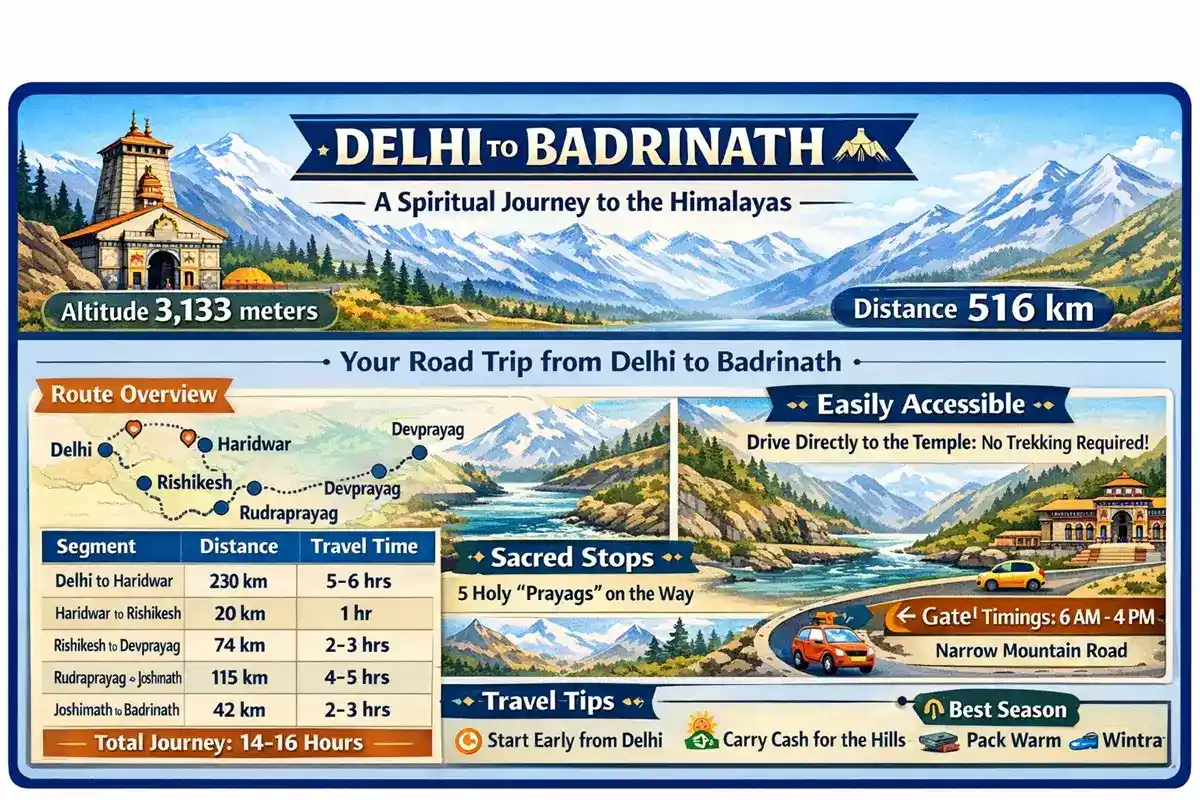
Delhi to Badrinath Distance & Travel Time
Let’s get the basics straight before you fuel up.
| Route Segment |
Distance |
Estimated Time |
Road Condition |
| Delhi to Haridwar |
230 km |
5-6 hours |
Excellent (Highway) |
| Haridwar to Rishikesh |
20 km |
1 hour |
Excellent |
| Rishikesh to Devprayag |
74 km |
2-3 hours |
Good, winding |
| Devprayag to Rudraprayag |
67 km |
2-3 hours |
Mountain roads |
| Rudraprayag to Joshimath |
115 km |
4-5 hours |
Narrow, scenic |
| Joshimath to Badrinath |
42 km |
2-3 hours |
Steep, controlled |
| Total Delhi to Badrinath |
~516-530 km |
14-16 hours |
Mixed terrain |
The total Delhi to Badrinath distance varies slightly depending on whether you take NH7 via Rishikesh or opt for the Kotdwar route. Most pilgrims cover this over two days, breaking the journey at Rudraprayag or Joshimath. Attempting it in one go is possible but exhausting—the mountain roads demand alertness, and fatigue can be dangerous on those curves.
What most people don’t realize is that the final 42 kilometers from Joshimath operate under a strict gate system. Traffic flows one way at regulated intervals to prevent jams on the narrow cliffside road. Miss the last gate at 4:00 PM, and you’re spending the night in Joshimath whether you planned to or not.
Best Route from Delhi to Badrinath (NH7 via Rishikesh)
This is the primary route that 90% of travelers take. It’s well-maintained, properly signposted, and offers the best balance of scenery and safety.
Detailed Route Breakdown:
Delhi → Ghaziabad → Meerut → Muzaffarnagar → Roorkee → Haridwar
Start early—like 4:00 AM early. The NH44 stretch is smooth, but Delhi’s outskirts get chaotic after sunrise. You’ll hit Haridwar by 9:00 AM, perfect for a breakfast stop and a quick dip if you’re spiritually inclined.
Haridwar → Rishikesh → Devprayag
Crossing into the hills begins here. At Devprayag, stop and witness the Alaknanda and Bhagirathi rivers merging to form the Ganges. It’s not just scenic—it’s mythologically significant. The confluence has an energy that photos can’t capture.
Devprayag → Srinagar → Rudraprayag → Karnaprayag
You’re now in the heart of Garhwal. The road hugs the Alaknanda, passing through Srinagar (not the Kashmir one—this is the Garhwal university town) and Rudraprayag, where the Mandakini joins the Alaknanda. This is your ideal overnight halt point. The town has decent hotels, medical facilities, and serves as the junction for Kedarnath pilgrims heading to Guptkashi.
Karnaprayag → Nandprayag → Chamoli → Joshimath
Karnaprayag marks the confluence of the Alaknanda and Pindar rivers. From here, the climb gets serious. Joshimath is your last major town before Badrinath—stock up on cash (ATMs are unreliable ahead), fuel up, and grab snacks. This is also where the road to Auli branches off.
Joshimath → Vishnuprayag → Govindghat → Pandukeshwar → Badrinath
The final stretch. Vishnuprayag is the last of the five prayags, where the Dhauliganga meets the Alaknanda. The road narrows significantly here, which is why the gate system kicks in. You’ll likely queue at the Joshimath checkpost before being allowed to proceed in batches.
Alternative Route: Delhi to Badrinath via Kotdwar
| Aspect |
NH7 via Rishikesh |
Kotdwar Route |
| Total Distance |
~516 km |
~560 km |
| Road Quality |
Better maintained |
Narrower, less maintained |
| Scenery |
River valleys, prayags |
Dense forests, quieter |
| Traffic |
Heavy during season |
Minimal |
| Best For |
First-timers, families |
Adventure seekers, offbeat travelers |
The Kotdwar route goes: Delhi → Meerut → Kotdwar → Pauri → Srinagar → Chamoli → Joshimath → Badrinath.
It’s longer and slower, but you’ll encounter far fewer vehicles. The Pauri stretch offers thick deodar forests and occasional Himalayan views that the main route misses. However, road conditions deteriorate during monsoons, and landslides are more common here. Only attempt this if you have a sturdy vehicle and some mountain driving experience.
How to Reach Badrinath from Delhi: Travel Options
By Road (Most Popular)
Self-Drive: If you own an SUV or a car with good ground clearance, driving yourself offers unmatched flexibility. The Delhi to Badrinath road trip allows spontaneous stops at viewpoints, tea stalls, and photo opportunities. Just ensure your vehicle is serviced—brake checks are crucial for the downhill stretches.
Private Taxi/Cab: Hiring a Delhi to Badrinath taxi is the stress-free option. Professional drivers know the gate timings, weather patterns, and safe overtaking spots. According to current rates, expect to pay ₹6,000 to ₹16,000 for a one-way trip depending on vehicle type (Sedan/Innova/Tempo Traveller).
Bus: Uttarakhand Roadways and private operators run buses from ISBT Kashmere Gate to Haridwar/Rishikesh. From there, you’ll need connecting buses or shared taxis to Badrinath. The bus fare from Delhi to Badrinath ranges between ₹700-₹1,200, making it the most economical choice.
By Train + Road
There’s no direct train to Badrinath. Your best bet is:
- Delhi to Haridwar/Rishikesh: 5-7 hours by train (Shatabdi, Jan Shatabdi, or overnight options)
- Haridwar to Badrinath: 10-12 hours by road (320 km)
This combination works well if you want to break the journey or if you’re prone to motion sickness on long bus rides. The train segment is comfortable, and you can hire a local taxi from Haridwar for the mountain portion.
By Air + Road
- Delhi to Dehradun (Jolly Grant Airport): 1-hour flight
- Dehradun to Badrinath: 10-12 hours by road (314 km)
Flights save time but add significant cost. The Jolly Grant Airport is small with limited connectivity, so book early. From the airport, prepaid taxis are available, but rates to Badrinath are steep—negotiate firmly or book through your hotel.
By Helicopter (Premium Option)
For those short on time or with mobility constraints, helicopter services operate from Dehradun to Badrinath. The Dehradun to Badrinath helicopter cost starts at approximately ₹70,000-₹75,000 per person for same-day return packages. Charter options for groups (5-6 passengers) run around ₹4,50,000.
The flight takes roughly 1 hour compared to 14+ hours by road. However, weather cancellations are common in the mountains, so always have a backup plan.
Best Time to Visit Badrinath
Timing your Delhi to Badrinath trip correctly can make the difference between a divine experience and a miserable, rain-soaked ordeal.
Approach 1: Peak Season (May-June)
Why go: Pleasant weather (18-20°C), temple ceremonies in full swing, all facilities operational.
Reality check: This is when everyone goes. Expect traffic jams at Joshimath, inflated hotel rates, and queues for darshan. Book accommodations at least a month ahead.
Approach 2: Post-Monsoon (September-October)
Why go: Clear skies after the rains, lush green landscapes, fewer crowds than summer, stable weather.
The sweet spot: Mid-September to mid-October offers the best balance. The monsoon landslide risk has passed, but the winter closure hasn’t begun.
When to Avoid
July-August (Monsoon): Heavy rainfall triggers landslides and cloudbursts. The 2013 Kedarnath disaster happened in June—monsoon months are genuinely risky. Roads wash away, and helicopter services frequently suspend operations.
November-April (Winter): The Badrinath temple closes around October/November (Vijayadashami or Bhai Dooj) and reopens in April/May. Temperatures drop to -18°C, roads become snow-bound, and the town is essentially inaccessible to regular tourists.
Badrinath Yatra Registration: Mandatory Process
Since the 2013 floods, registration has become compulsory for all Char Dham pilgrims. This isn’t bureaucracy for its own sake—it helps authorities track visitor numbers, send weather alerts, and coordinate rescue operations if needed.
How to Register:
- Online: Visit the official Uttarakhand Tourism portal (registrationandtouristcare.uk.gov.in) and complete the eKYC process using your Aadhaar.
- WhatsApp: Save +91 8394833833 and message “Yatra” to start the registration process .
- Offline: Registration centers operate at Rahi Hotel in Haridwar and ISBT/Gurudwara in Rishikesh .
Checkpoints: Your registration will be verified at Pandukeshwar (Badrinath checkpoint). Keep your QR code or confirmation message handy.
Registration is free and takes minutes. Don’t skip it—checkpoints are strict, and you won’t be allowed to proceed without it.
Cost Breakdown: Delhi to Badrinath Trip Budget
Here’s what you’ll actually spend, based on 2025 rates for a 3-day/2-night trip:
| Expense Category |
Budget Option |
Mid-Range |
Premium |
| Transport (round trip) |
₹1,400 (bus) |
₹12,000 (shared taxi) |
₹25,000+ (private cab) |
| Fuel (if self-driving) |
₹8,000-10,000 |
– |
– |
| Accommodation (2 nights) |
₹1,600 (₹800/night dormitory) |
₹6,000 (₹3,000/night hotel) |
₹16,000+ (₹8,000+/night) |
| Meals (3 days) |
₹1,500 |
₹3,000 |
₹6,000 |
| Temple donations/Puja |
₹500 |
₹2,000 |
₹5,000+ |
| Miscellaneous |
₹1,000 |
₹2,000 |
₹5,000 |
| Total per person |
₹6,000-8,000 |
₹25,000-30,000 |
₹60,000+ |
Accommodation specifics: Budget hotels and dharamshalas in Badrinath charge ₹800-₹2,000 per night. Mid-range options like Hotel Dwarikesh or New Hotel Snow Crest run ₹2,000-₹5,000. The only luxury property is Sarovar Portico at ₹8,000+
. GMVN guest houses offer the best value—book online at gmvn.in.
Pro tip: Carry cash. Network connectivity is patchy, and card machines rarely work in the mountains. ATMs exist in Joshimath but often run dry during peak season.
The Joshimath Gate System: Critical Information
This is where most first-timers get caught off guard. The 42-kilometer stretch from Joshimath to Badrinath is too narrow for two-way traffic. To prevent chaos, authorities operate a gate system with specific opening times.
Joshimath to Badrinath Gate Timings:
- 6:00 AM, 8:00 AM, 10:00 AM, 12:00 PM, 2:00 PM, 4:00 PM
Badrinath to Joshimath Gate Timings:
- Similar staggered schedule for return traffic
Critical rules:
- The last gate from Joshimath closes at 4:00 PM sharp
- Arrive after 4:00 PM, and you’re staying in Joshimath overnight—no exceptions.
- Roads close completely at 5:30 PM for all vehicles except local taxis (allowed until 8:00 PM) .
- Morning movement resumes at 5:00 AM.
Plan your departure from Delhi so you reach Joshimath by 2:00 PM latest. This gives you buffer time for traffic delays and ensures you catch a gate slot. During peak season (May-June), queues at the Joshimath checkpost can stretch for hours—factor this into your timeline.
Places to Visit Near Badrinath
Don’t just touch the temple and leave. The Badrinath region packs extraordinary sights within a 50-kilometer radius.
Mana Village (4 km from Badrinath)
India’s last inhabited village before the Tibet border. Walk through stone-paved lanes, visit the Vyas Gufa (where Ved Vyasa composed the Mahabharata) and Ganesh Gufa (where Lord Ganesha wrote it down). The “Last Tea Stall of India” here serves surprisingly good Maggi with Himalayan views .
Vasudhara Falls (9 km from Badrinath)
A 6-kilometer trek from Mana Village leads to this 400-foot waterfall. The trail is moderate but stunning—alpine meadows, snow peaks, and the roar of falling water. Legend says the waterfall only touches those with pure hearts
. Budget 3-4 hours for the round trip.
Tapt Kund (Below Badrinath Temple)
Natural hot sulfur springs where the water maintains a constant 45°C. Pilgrims bathe here before temple darshan—the mineral-rich water is believed to cure skin ailments. Entry is free.
Bhim Pul (3 km from Badrinath)
A massive natural rock bridge over the Saraswati River. Mythology says Bhim placed it here so Draupadi could cross. The river Saraswati emerges from a glacier here, flows visibly for a few kilometers, then mysteriously vanishes underground.
Auli (57 km from Badrinath)
India’s premier skiing destination. If you’re visiting in winter (though Badrinath itself will be closed), Auli offers snow sports. In summer, it’s a meadow paradise with the second-longest ropeway in Asia (4.15 km). The Joshimath-Auli ropeway costs ₹1,000 round trip.
Valley of Flowers & Hemkund Sahib (43 km to Govindghat + trek)
From Govindghat (25 km before Badrinath), a 17-kilometer trek leads to the UNESCO World Heritage Valley of Flowers (July-September) and the Sikh pilgrimage site of Hemkund Sahib.
Essential Travel Tips for Delhi to Badrinath Road Trip
What to Pack:
- Warm layers (temperatures drop to 5°C even in summer)
- Waterproof jacket (mountain weather changes instantly)
- Sunglasses and sunscreen (UV is intense at altitude)
- Basic medicines for altitude sickness, headaches, and stomach issues
- Power bank (electricity cuts are frequent)
- Valid ID proof (registration and hotel check-ins require it)
Health Precautions:
- The altitude (3,133 meters) can trigger AMS (Acute Mountain Sickness). Symptoms include headache, nausea, and breathlessness.
- Spend a night at Joshimath or Rudraprayag to acclimatize rather than rushing from Delhi to Badrinath in one go.
- Avoid alcohol and heavy meals on arrival.
Vehicle Preparation:
- Check brakes, tires, and coolant before departure.
- Carry spare fuel in a certified jerry can (petrol pumps are scarce after Rudraprayag).
- Download offline maps—mobile data dies after Joshimath.
Safety Notes:
- Don’t drive after dark in the mountains. Landslides, falling rocks, and stray animals make night driving dangerous.
- If you feel uneasy about a road section, wait for a local vehicle and follow their line.
- Respect the gate timings—trying to bypass them risks accidents and heavy fines.
Common Mistakes to Avoid
Mistake 1: Attempting Delhi to Badrinath in one day.
Reality: You’ll arrive exhausted, possibly after dark, and miss the gate cutoff. Break the journey.
Mistake 2: Ignoring registration.
Reality: You’ll be turned back at Pandukeshwar checkpoint. Complete it 2-3 days before travel.
Mistake 3: Booking accommodation on arrival.
Reality: During peak season, Badrinath has more pilgrims than beds. Book online or risk sleeping in your vehicle.
Mistake 4: Carrying only cards/digital wallets.
Reality: The mountains run on cash. Carry enough for the entire trip.
Mistake 5: Disrespecting altitude.
Reality: Rushing to Badrinath without acclimatization can ruin your trip with severe altitude sickness.
Frequently Asked Questions
Q: Is there any direct bus from Delhi to Badrinath?
No direct buses operate the full route. You must change at Haridwar or Rishikesh. The total bus journey takes 18-20 hours with connections.
Q: Can we go to Badrinath by our own car?
Absolutely. The road is motorable throughout, and unlike Kedarnath, no trekking is required. SUVs are recommended for comfort, but sedans can manage if driven carefully.
Q: What is the Badrinath temple opening date for 2025?
The temple typically opens in late April or early May (around Akshaya Tritiya). For 2025, the expected opening is around May 10, with the official date announced on Basant Panchami (February) .
Q: Is oxygen required for Badrinath?
Most healthy adults don’t need supplemental oxygen at 3,133 meters. However, if you have respiratory issues or experience severe AMS symptoms, portable oxygen cylinders are available at medical centers in Badrinath.
Q: How many days are sufficient for Delhi to Badrinath trip?
Minimum 3 days/2 nights: Day 1 Delhi to Rudraprayag/Joshimath, Day 2 Badrinath darshan and local sightseeing, Day 3 return. Add a day if you want to include Auli or Mana Village trek.
Q: Is Badrinath safe for solo female travelers?
Yes, thousands of solo women travelers visit annually. The temple town is crowded and well-patrolled during season. Standard precautions apply—avoid isolated areas after dark and inform someone of your itinerary.
Final Thoughts: Making Your Delhi to Badrinath Journey Count
The Delhi to Badrinath distance of 516 kilometers isn’t just a number—it’s a transition from the chaos of city life to the serenity of the high Himalayas. Every prayerag you cross, every mountain turn you navigate, brings you closer to something ancient and profound.
Plan smart. Register in advance. Respect the mountains. Carry cash. And most importantly, don’t rush. The road to Badrinath is as much the destination as the temple itself. When you finally stand before the black stone idol of Lord Badri, with the Neelkanth peak towering behind and the Alaknanda rushing below, you’ll understand why millions undertake this journey despite the challenges.
Safe travels, and Har Har Badri Vishal!
Suggested Tour:

 Call
Call WhatsApp
 Enquiry